Hiking Montserrat: the Funiculars, the Hermitages and Sant Jeroni
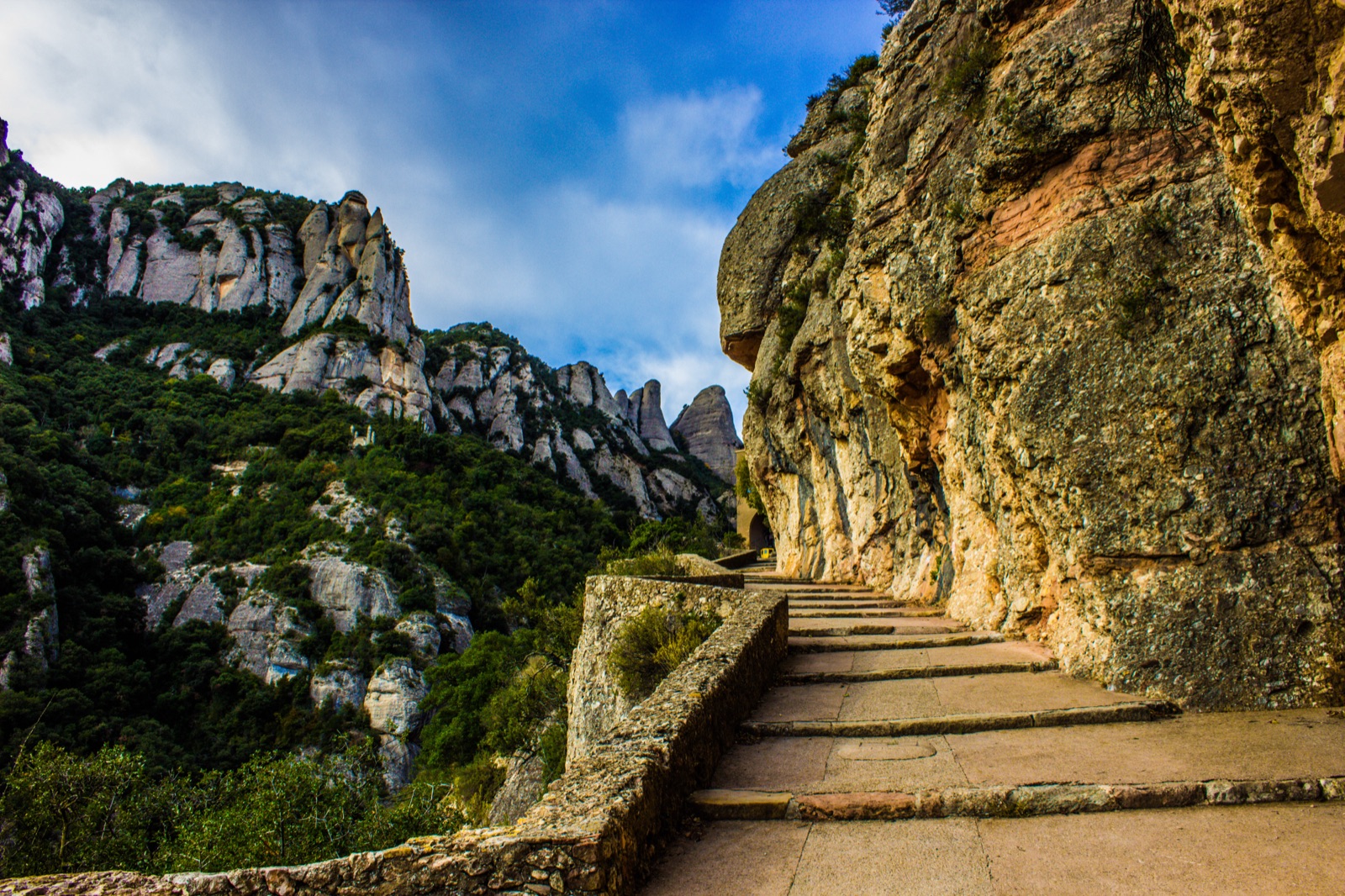
For many visitors the monastery is Montserrat. But the sanctuary sits on a ledge below one of the strangest landscapes in Europe: a mass of rounded rock towers, pinnacles and ridges, cut by ravines and dotted with the ruins of old hermitages. Walking up among them, with the monastery shrinking below and the plains of Catalonia spread out beyond, is the part of a visit that many people remember longest.
You do not need to be a mountaineer or an experienced hiker to enjoy it. Two funiculars do the hardest climbing for you, and the natural park maintains signposted routes of different lengths. This guide covers both funiculars, the park’s hermitages route and the walk to the summit of Sant Jeroni, and explains how to fit them into a day.
Getting to the trailheads
All the walks in this guide start at, or just above, the monastery, so getting to the trailhead means getting to the sanctuary first.
- By train: FGC line R5 from Barcelona–Plaça Espanya runs hourly and connects with the rack railway (15 minutes from Monistrol, every 20 minutes from Monistrol Vila) and the Aeri cable car (every 15 minutes).
- By coach: the daily coach leaves Plaça dels Països Catalans, next to Sants station, at 9:15 and returns from Montserrat at 17:00 — fine for the shorter walks, tight for Sant Jeroni.
- By car: parking at the monastery is €4 per car per day, with the first 30 minutes free; the rack railway car park at Monistrol Vila is free.
From the monastery, the funiculars leave from beside the sanctuary. Our guide to getting to Montserrat compares every option in detail.
The two funiculars
The funiculars leave from beside the monastery. They were built to take pilgrims and visitors to the most emblematic places on the mountain: the Sant Joan funicular in 1918 and the Santa Cova (Holy Grotto) funicular in 1929.
The Sant Joan funicular
The Sant Joan funicular goes up. It climbs to 1,000 metres over gradients of up to 65.5% — one of the steepest rides you are likely to take — in just seven minutes. At the top, Pla de les Taràntules is a level area with wide views over the monastery and the Catalan countryside.
This is the gateway to the upper mountain. The hermitages route and the route to Sant Jeroni both pass through Pla de les Taràntules, and beside the upper station the Aula de Natura explains the mountain’s history, fauna and flora. If you only have time for one funicular and you want to walk, this is it.
The Santa Cova funicular
The Santa Cova funicular goes down. It takes you to the start of the path to the Holy Grotto, the place where, according to tradition, the image of the Virgin was found. The path is lined by the Monumental Rosary, the most important open-air group of Catalan modernist sculpture: a series of monuments set against the rock along the way.
It is a gentler, more contemplative outing than the Sant Joan side, and it suits visitors who want to combine a walk with the pilgrimage story of Montserrat.
The hermitages route
The natural park’s hermitages route is the best introduction to walking on Montserrat.
- Distance: 7 km.
- Time: about 2 hours.
- Difficulty: low.
- Start: the monastery.
The route
From the monastery, paths divide: one heads for the Santa Cova and the Collbató road, one runs level along the Camí de les Bateries, and one climbs steeply towards Sant Joan. The hermitages route takes the steep one, climbing to Pla de les Taràntules beside the upper station of the Sant Joan funicular and the Aula de Natura.
From there it follows the Camí de Sant Joan to the chapel of Sant Joan, and a little higher to the remains of the old hermitages of Sant Joan and Sant Onofre, set into a long cleft in the rock. Along the overhang you can see carvings in the stone that are many centuries old. The restored Jacob’s Ladder gives access to the hermitage of Santa Magdalena.
To finish, you can return the same way to the monastery, or take the Sant Joan funicular down from Pla de les Taràntules.
Why it is worth doing
The hermitages route shows you a side of Montserrat that the monastery square does not: the mountain as a place of solitude, where hermits lived in caves and clefts high above the valley. It combines history, rock scenery and views, and its low difficulty makes it suitable for most visitors who are comfortable on uneven paths.
Making it easier
If the steep climb at the start does not appeal, take the Sant Joan funicular up and join the route at Pla de les Taràntules. You miss the climb but keep the chapel, the hermitages and the views.
The summit of Sant Jeroni
Sant Jeroni is the highest point of Montserrat, and the walk to it is the classic hike on the mountain.
- Highest point: 1,236 m.
- Lowest point: 712 m.
- Distance: 7 km.
- Time: about 2 hours 30 minutes.
- Difficulty: medium.
- Start: Pla de les Taràntules, reached by the Sant Joan funicular.
The natural park’s signposts guide you along the route, and on a clear day the view from the top takes in much of Catalonia. It is a real mountain walk — on rocky paths, with steps and some steep sections — and it deserves proper shoes, water and a clear forecast.
Planning the Sant Jeroni walk
- Start early. The walk takes about 2 hours 30 minutes, and you will want time at the top and a margin for the last funicular or train down.
- Use the funicular. Starting at Pla de les Taràntules, rather than at the monastery, saves a steep climb before the route begins.
- Check the weather. In low cloud the views disappear and the paths are harder to enjoy.
- Know your way down. Decide before you set off whether you will return to Pla de les Taràntules and the funicular, or walk all the way down to the monastery.
Which walk to choose
| Walk | Distance | Time | Difficulty | Best for |
|---|---|---|---|---|
| Santa Cova path | Short | Relaxed | Easy | The Monumental Rosary and the pilgrimage story |
| Hermitages route | 7 km | About 2 hours | Low | History, hermitages and views |
| Sant Jeroni | 7 km | About 2 hours 30 minutes | Medium | The summit and the widest views |
- Short on time or energy: the Santa Cova path, or the Sant Joan funicular up and a stroll around Pla de les Taràntules.
- A good walk without a summit: the hermitages route.
- The full experience: Sant Jeroni.
What to bring
The paths above the monastery are rocky, exposed in places and without shops or cafés. Bring:
- Walking shoes or boots with a good grip. The rock is often smooth and the paths uneven.
- Water. There is nowhere to buy it once you leave the monastery and the funicular stations.
- Sun protection. Much of the upper mountain has little shade.
- A layer. The summit is well above the monastery and can be windy.
- A map or the park’s route description, even though the routes are signposted.
Fitting a walk into your day
With the train
Take the R5 from Barcelona–Plaça Espanya, which runs hourly, and the rack railway or the Aeri up to the monastery. Start walking by mid-morning, and check the time of the last rack railway or Aeri down — and the train connection back to Barcelona — before you set off on a longer route.
With a tour
Most half-day tours from Barcelona leave limited free time, enough for the Santa Cova path or a funicular ride but not for Sant Jeroni. The tour with the rack railway and a winery includes free time on the trails during a 6- to 9-hour day, and the Tot Montserrat ticket gives you your own schedule on the mountain with lunch included.
With the monastery
If you want both the monastery and a walk, plan around the fixed times: see the Black Madonna in the morning session (8:00 to 10:30), hear the Escolania at 13:00 (check the monthly calendar), and walk in the afternoon. Our guide to visiting the monastery has the details.
Two sample walking days
A relaxed half day on the mountain
Arrive at the monastery in the morning and take the Sant Joan funicular up to Pla de les Taràntules — seven minutes of steep climbing with the monastery falling away beneath you. Spend some time at the Aula de Natura to understand what you are looking at, then follow the Camí de Sant Joan to the chapel and the old hermitages of Sant Joan and Sant Onofre in their cleft in the rock. Look for the ancient carvings along the overhang. Walk back to Pla de les Taràntules and ride the funicular down in time for lunch, or for the Escolania at 13:00.
In the afternoon, take the Santa Cova funicular down and walk the path past the Monumental Rosary to the Holy Grotto. It is a quieter, more reflective walk, and a good contrast to the morning.
A full day with the summit
Catch an early R5 from Plaça Espanya and ride the rack railway or the Aeri up. Take the Sant Joan funicular to Pla de les Taràntules and set off for Sant Jeroni: 7 km and about 2 hours 30 minutes on the park’s route, following the signposts to the summit at 1,236 m. Eat your picnic with the view, then walk back and either ride the funicular down or continue on foot to the monastery. Leave time to see the Basilica before the last connection back to Barcelona.
When to walk
Montserrat can be walked in every season, but each brings its own considerations.
- Summer brings long days but strong sun on paths with little shade. Start early, carry more water than you think you need, and rest in the shade when you find it.
- Spring and autumn are the most comfortable seasons for most walkers, with milder temperatures for the climbs.
- Winter has shorter days, so plan the route around the daylight and the last funicular and train down. Clear winter days can give the sharpest views of all.
Whatever the season, check the forecast before a longer walk. Low cloud can hide the views completely, and wet rock is slippery.
Staying safe on the upper paths
The routes described here are well used and signposted, but they are mountain paths, and a few simple habits keep a good day from going wrong.
- Tell someone your plan if you are walking alone.
- Watch your footing on smooth or wet rock, and on steps.
- Keep to the marked paths. The rock towers are for climbers with equipment, not walkers.
- Turn back if the weather turns. The views will be there another day.
- Know the time of the last funicular and train. Missing the last connection down is the most common way for a relaxed walk to become a stressful one.
Where to take the best photographs
- Pla de les Taràntules, at the top of the Sant Joan funicular, for the classic view down onto the monastery.
- The hermitages of Sant Joan and Sant Onofre, for the drama of buildings set into the rock.
- The Monumental Rosary, on the Santa Cova path, for sculpture framed by cliffs.
- Sant Jeroni, for the widest panorama over Catalonia.
Walking with children
Montserrat can be a wonderful walking day for families, if you choose well.
- The funiculars are half the fun. The Sant Joan funicular’s steep climb in seven minutes delights most children.
- Keep the distances short for younger ones: a stroll around Pla de les Taràntules, the Aula de Natura and back down on the funicular.
- The hermitages route suits older children, with its caves, carvings and Jacob’s Ladder.
- Hold small hands near drops. The upper paths are exposed in places.
Respecting the natural park
The whole mountain is a natural park, home to plants and animals that depend on the undisturbed rock and scrub. Stay on the marked paths, take your litter home, keep noise down near the hermitages and chapels, and leave the plants and rocks as you find them. The routes described here follow the park’s own itineraries and signposts, which exist to protect the mountain as much as to guide you.
Frequently asked questions
How long is the hike to Sant Jeroni?
The natural park’s route from Pla de les Taràntules to the summit is 7 km and takes about 2 hours 30 minutes. It is of medium difficulty and reaches 1,236 m.
How do I get to the start of the Sant Jeroni hike?
Take the Sant Joan funicular from beside the monastery to Pla de les Taràntules. It climbs to 1,000 metres in seven minutes.
Is there an easy walk at Montserrat?
Yes. The natural park’s hermitages route is 7 km, takes about 2 hours and is of low difficulty. The Santa Cova path, along the Monumental Rosary, is another gentle option.
When were the funiculars built?
The Sant Joan funicular in 1918 and the Santa Cova funicular in 1929.
Can I walk down instead of taking the funicular?
Yes. On the hermitages route you can return to the monastery on foot or take the Sant Joan funicular down from Pla de les Taràntules.
What should I wear for hiking at Montserrat?
Walking shoes with a good grip, sun protection and a warm layer, and carry water — there is nowhere to buy it on the upper paths.
Is the Santa Cova walk difficult?
No. The Santa Cova funicular takes you down to the start of the path, which runs past the Monumental Rosary to the Holy Grotto. It is one of the gentlest walks on the mountain.
Can I do Sant Jeroni on a day trip from Barcelona?
Yes, if you start early. Take the R5 from Plaça Espanya and the rack railway or the Aeri up, then the Sant Joan funicular to Pla de les Taràntules. The walk to the summit takes about 2 hours 30 minutes on the park’s route, so leave a comfortable margin for the last connections back to Barcelona.